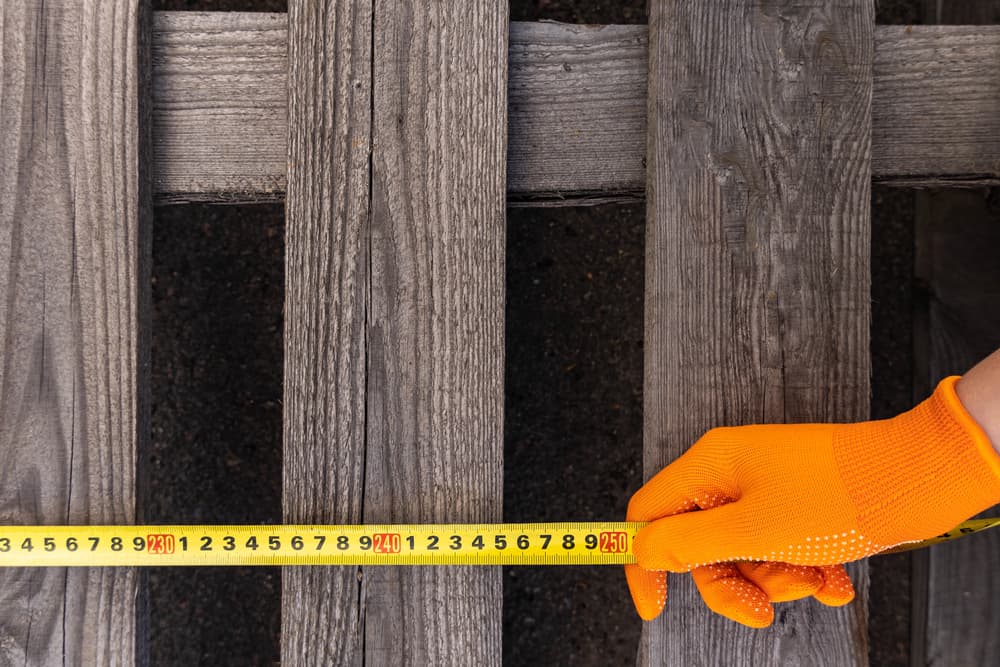
Calculating your timber needs means measuring the total length of your fence line. You should also choose your fence style and materials, and work out how many posts, rails, and pickets you’ll need. Remember to add a little extra for waste and future repairs, too.
Getting this right helps you avoid costly mistakes and wasted materials.
In this guide, we’ll walk you through the full process, plus provide a few tips to get your measurements right.
Step 1: Determine Your Fence Dimensions and Style
Start by measuring the perimeter of the area you want to enclose. Use a measuring tape to find the total fence length in metres.
- For simple shapes, just measure each straight side and add them up.
- For angled or curved fences, measure each one and then add them all together.
Remember to note any gate openings or special areas, like a garden entrance, since these might need different materials or spacing.
Next, decide on:
- Fence length: the total length of fencing in metres
- Fence height: common heights include 1.5m or 1.8m
- Fence style: like paling, lapped and capped, or horizontal slats
Your chosen style of timber fence will affect how much timber you need, especially for rails and pickets. Getting these details right helps make the next steps much easier.

Step 2: Calculate the Timber Requirements
Now that you know your fence dimensions, it’s time to work out how much timber you’ll need. This includes posts, rails, palings, and possibly a plinth board.
1. Posts
Fence posts are usually 2.4m to 2.7m apart. To find out how many you need, here’s an example:
- For a 16.5m fence with 2.4m spacing, divide your fence length by the post spacing, then add 1.
- That means, 16.5 ÷ 2.4 + 1 = 7.875, or 8 posts. Always round up if needed.
Remember that fence posts should be long enough to sink at least 600mm into the ground. Also, be sure their size matches your fence height and soil conditions.
2. Rails
Typically, shorter fences under 1.2m use two rails, while taller fences, around 1.8m, use three or more. To calculate the number of fence rails, you need to know your fence’s height and the number of horizontal rails per section:
- Let’s say you have a fence that is 16.5m long and 1.8m tall with 2.4m spacing. Since the fence height is 1.8m, you need three rails per section.
- Next, compute the number of sections by dividing the total fence length by the distance between posts, then add 1. That means, 16.5 ÷ 2.4 + 1 = 6.875, or 7 sections. Always round up if needed.
- Then, compute the total rails by multiplying the number of sections by the number of rails per section. That is 7 sections x 3 rails per section = 21 rails.

3. Palings
To compute the number of palings for a timber fence, you need the fence length, the paling width, and your ideal spacing between palings.
Common paling widths are 75mm, 100mm, and 150mm. The spacing between palings, however, can vary, but 25mm or 50mm is common. Timber fences for partial or full privacy often have no gaps between palings.
Let’s use these numbers for a sample computation of a 16.5m-long fence:
- First, calculate the paling coverage per unit by adding your desired paling width and spacing between palings. For example, 100mm (paling width) + 25mm (spacing) = 125mm or 0.125m paling coverage per unit.
- Next, calculate the total palings by dividing the fence length by the coverage per paling. That means, 16.5m ÷ 0.125m = 132 total palings. Always round up to the nearest whole number.
You can also use the standard rule of 5 palings per metre as a quick estimate, but precise measurements yield optimal results.
4. Plinth Boards (Optional)
Plinth boards are horizontal timber pieces placed at the base of a paling fence. These provide a physical barrier to deter animals, prevent soil erosion, and improve the overall fence stability.
If adding one, calculate the total plinth boards needed by multiplying your fence length and the plinth board length. In Australia, 2.7-m plinth boards are the most common.
That means a 16.5m-long fence would require 44.55 or 45 plinth boards.
Since you cannot buy parts of a plinth board, round the result up to the next whole number. Be sure to consider the overlaps between boards, especially when you need to cut them to fit your fence sections.
Step 3: Add 10% for Waste and Repairs
It’s always best to order a little extra timber for your fence project. Mistakes happen, after all. You could cut a board too short, find a warped post, or need to replace a paling down the track.
That’s why adding 10% extra to your total count is a good rule of thumb.
Here’s what you should add 10% to:
- Posts: in case one cracks or leans
- Rails: in case you cut one too short
- Boards or palings: for offcuts or future replacements
So, if your fence project requires 132 palings, multiply it by 0.10 to purchase 13.2 or 14 extra palings.

Additional Tips for Accurate Timber Estimates
Getting your timber count right is more than just basic maths. Here are a few extra tips to make sure your estimate is spot-on:
- Account for slopes and hills. If your yard isn’t flat, you might need to cut boards to different lengths or add extra posts to keep your fence level and neat.
- Consider gate posts. Gate posts hold more weight, so use thicker, stronger timber and set them deeper with more concrete.
- Use a fence calculator. Online fencing calculators (especially ones tailored for Australia) can make your timber fence calculation much easier and more accurate.
- Consult local suppliers. Your local timber or fencing experts can help you choose the right materials and calculate exactly how much you need based on your layout and soil.
Get Your Timber Estimate Right
Before starting on your fencing project, make sure you’ve measured your fence line carefully, chosen your style, and done the maths to figure out your timber needs.
Be sure to add 10% for waste and future fixes. Also, keep things like sloped ground, gate posts, and timber quality in mind as these all make a difference in the final result.
A little planning now saves you time, money, and stress later.
If you want expert help with timber selection or fence installation, contact us on 0452 280 559 or visit our contact page. Our team will guide you through the process and make sure your fence project goes smoothly.